19 July 2022

Aloha! Hawaii - December 2021

We arrived in Hawaii on a sunny evening on December 2, with the temperature in the lower 80's and humidity at a stifling level. Our Santa Barbara friend, Janette, who was also on the island (she grew up here), chauffeured us from the airport to our elegant studio apartment in the heart of residential Kailua. She handed us a bag of luscious local fruit - mangoes, papayas and bananas -the special variety that are thick and short called apple bananas. The tropics in midwinter! Plumeria scented air, swaying palms, bright flowers of ginger plants in the garden at our apartment's entrance - my brain instantly fell into vacation mode.

Kailua Beach at Sunrise

We awoke at sunrise on our first morning and marched through the elegant neighborhood down to Kailua Beach. The sand, powdery and white and the water, a thrilling turquoise, gave me goosebumps. Especially because the volcanic landscape around the crescent shaped beach was unspoiled. Here, on the windward coast of Oahu there were no high rise resorts. Beyond the reef we could see huge waves breaking over the wall of coral. At this early hour the air temperature was perfect. We removed our sandals, feet sinking into soft sand, a sensation that would be worth paying money for. Many locals were on the beach walking their dogs, their friendly smiles and greetings offering a reassurance of a blissful last phase of our time away from home.

We acquired Holo cards and hopped on a bus to Honolulu on our first Saturday. We rode through the Pali Pass, awestruck by the scenery. Vertical volcanic flanks and deep, lush valleys. Neighborhoods tucked into valley folds, dense vegetation from ample rain, and the ocean visible even from the heart of the island. We strolled through the Chinatown part of downtown, absorbing the authentic exoticism in which we were immersed. Too bad we couldn't go wild stocking up on produce from the open market stalls. The stores were entertaining too with their unbelievable inventory of Asian culinary items. 

From Chinatown we hopped on a bus to Waikiki, where we whiled away much of the day. It was so different to what I'd experienced back in Jan 2020. A fraction of the tourists. No vivacious Asian tour groups. Quiet streets. Empty restaurants. At the International Marketplace we gawked at the enormous banyan tree and admired paintings of the island's landscape at a gallery.

 The weather changed abruptly two days after our arrival. An epic storm system rolled over the archipelago. Rain pelted down for days. Hawaii was no paradise as gusty winds, cool temperatures, a rough ocean and power losses greeted us. The governor issued a warning about high bacteria levels in the ocean making it unsafe to go into the water. Due to flood watches, fallen palm fronds, tree limbs, etc we were stuck indoors. The two beaches near us - Kailua Beach and Lanikai Beach - have a reputation for being the prettiest ones on Oahu. The sand is white, powdery, soft and the water normally turquoise and calm. But during and after the storms that had made national news, the water turned brown and rough. 

Car rental in these pandemic times had become a challenge. Agencies faced a dual hardship, first due to a lack of business when nobody was traveling in 2020 and then, when travel resumed in early 2021, they had to deal with a greatly reduced inventory due to fewer cars manufactured at factories. When we looked into car rental for our Hawaii trip the prices that came up were shocking. Then, through the Kayak website, we discovered Turo, an online car rental agency where individuals rent out their private cars at budget rates. While in Kailua we rented a car multiple times from private individuals who lived near our Airbnb apartment.


On our first driving excursion, when the sky finally had more blue than grey, we explored the southern part of Oahu. On the Makapuu Lighthouse trail - incredibly popular on a Saturday morning - we trudged up the steep incline for stupendous views. Continuing south, Koko Head, the highest peak on the island, dominated the landscape. We stopped at Sandy Beach to wash off the mud that stuck to our shoes from the hike. After a rugged coastal stretch we arrived at the KCC farmers market at the foot of Diamond Head. 

Koko Head Crater


We stocked up on local produce - tropical fruits, okra, eggplant and green beans - before continuing west, through Honolulu and onto the Pali highway back to Kailua.


On another day we drove on the impressive H3 highway which took us through a stunning tunnel. Then we looped up to the North Shore, hung out at the peaceful Haleiwa Beach Park, continued on to Sunset Beach for a stroll and to check out the famous towering waves, and made one more stop at Turtle Bay Resort. A spectacular setting for the lone 5 star resort at this untamed part of the island. Though the ocean here was rough in the winter months, there were pools created by reefs that were perfect for swimming. The lobby area of the resort was huge with inviting lounge areas, a bar and a café, all facing the ocean.


Heading east to the windward side on the north shore coastal road - the Kamehameha Highway - the scenery was constantly entertaining. Calm bays fringed by mangrove swamps gave way to rough ocean. We drove past shrimp trucks, fruit stands, small towns, and parks.

North Shore, Oahu


A week later we were back at Turtle Bay Resort to dine at the upmarket restaurant owned by Roy Yamaguchi, Hawaii’s most well-known chef. Its location, right on the beach, guaranteed an experience to savor. We arrived in the middle of the afternoon to enjoy the public park and beaches adjacent to the resort. Just before dinner we strolled through the landscaped section of the resort. A bench on a point begged to be sat on. We gazed at the vast expanse of choppy blue water below us. Suddenly a humpback whale breached. A spellbinding moment. Seconds later it emerged from the water again. And again.


Maitai at Turtle Bay
As we settled down at our dinner table the sun was setting and the ocean took on hues that made you wish time would stand still. We sipped Mai Tai's because such a view deserved the island's famous cocktail. We didn’t love the Japanese inspired set vegetarian meal, but it was a pretty indulgent experience, and a wonderful conclusion to a perfect day. 


The memory of that outing lingered and on Christmas Day we returned to Turtle Bay where the variety of ways to while away time ensured a great day. We spent a fair amount of time just sitting on our beach chairs eating, reading and watching the surf. The air temperature was beautifully mild. After lunch we went on a gentle hike, following the trail along the coast, to the northernmost point of Oahu. From here we headed inland, into a pine forest before looping back to the coast. Late afternoon we went into the natural pool for a swim. By then the air temperature had dropped to the point that we were chilled in the water. until we got home and under a hot shower!


On the weekend after Christmas we drove to the westernmost part of the north shore and hiked the Ka'ena Point trail. Because of the intense heat that guaranteed a migraine for me we couldn't do the full trail. Most disappointing. However, every time we looked at the ocean we saw whales in action. Such a joy! The scenery, too, was just so stunning. 


On the drive back to Kailua from Ka'ena we had a memorable meal experience at a vegetarian Indian restaurant called Maharaja's in a funky town just past the Dole Plantation. It was a humble, informal place, buffet style, allowing for choice and quantity and you paid by weight. Though they'd run out of their best items when we had arrived at 6:00, the food was delicious - flavorful, but not hot. The owner told us the chef was Bengali. "Better to come at lunch time when everything is still fresh and plentiful," she advised.

We enjoyed this authentic, non-tourist piece of the island.


While weekends were for excursions around the island, on weekdays we spent much of the day in the apartment engaged in our individual projects. I did a lot of reading. I went on a Damon Galgut kick after reading The Promise for which the author had recently won the Booker Prize. I admired his writing style. Also, his post-apartheid themes and South African settings were of particular interest to me. 

Lanikai Beach


Late afternoon we donned bathing suits and strolled to Kailua Beach most days. Sometimes we went further - to Lanikai Beach which was always much calmer. Even though we were on these beaches every day we were always struck by the overwhelming beauty. Early in December the afternoons were blustery and windsurfers made for a colorful sight on the water. Later in the month, the weather stabilized, the water grew calmer and the beaches became quite crowded. Much of the beach was in shade at that time of day, allowing for enjoyable long walks which ended in a refreshing dip in the calm water. On our walk back to the apartment the Pali would take on compelling shades as the sun disappeared.

Sunset from a fine Italian Restaurant near Waikiki Beach


A month of immersion in such intense natural beauty was truly a privilege. Especially during a pandemic.


Omicron

Covid news all December was dominated by the Omicron variant. One scientist compared the pandemic to a game of Snakes and Ladders. With the Delta variant we landed on a snake and had to go back in our progress. In early December nobody could tell what square Omicron landed on.

For the first half of December 2021 we anxiously observed what the new "scariant" was unleashing in South Africa. Their positivity rate hit 34%. Their daily case numbers doubled every 3 days, though the reported counts didn't reflect reality. Infectious diseases experts interviewed on South African news stations compared the surge to a tornado sweeping across the country. A significant percentage of the population were either asymptomatic or experienced mild symptoms and never bothered to get tested. Apart from urging mask wearing and avoiding crowded indoor spaces, no restrictions were imposed by the government. The country's health experts projected hope as they observed a different landscape to previous variant driven surges. Hospitalizations were low, symptoms were mild, ICU's weren't in demand. Their initial assessments were holding true. The experts pointed to high seroprevalence in the population to explain the phenomenon. Over 70% of South Africans had been previously infected by the coronavirus. A third of the population was fully vaccinated. 

In mid-December when South Africa reached its omicron peak, the variant had penetrated every country in the world, despite travel bans to southern African countries. Europe was in the grips of a winter Delta spike. In the US covid cases were rising too, driven by the Delta variant. Once omicron entered the scene everyone held their breath. In South Africa delta was pretty much nonexistent. As Christmas approached and South Africa began a steep descent in covid numbers, it became clear that omicron would wipe out delta. Meanwhile, hospitals were still treating patients sickened by the delta variant. Exasperatingly, everyone could be infected by the new version of the coronavirus. 

By early January much of the world was in the grips of omicron. Even Australia was struggling with eye-popping new daily cases. France, Italy and the UK were reporting over 200,000 new daily cases. The US breached a million new daily cases. The consequences were different in this wave. Now there was a shortage of personnel everywhere - in health care settings, services, all industries. Airlines had to cancel flights due to the large number of covid infected crew. Broadway shows were cancelled. Stores endured supply shortages. Hospitals were short staffed. Nevertheless, life appeared normal. Lockdowns and stay at home orders belonged to 2020. Government intervention was to urge vaccination, masking, testing when symptomatic, promising better supplies of rapid home test kits and beefing up hospital resources.

Despite the heavy prevalence of the disease we were undoubtedly in a new stage of the pandemic. Everyone felt sure the January crisis would be short-lived. South Africa's 4th wave was described by a heath official as an "ice-pick". Other countries hoped for the same. We kept hearing about endemicity as the pandemic's end game. And Omicron, a hyper transmissible variant, was perhaps a gift, that hastened the process. In the game of Snakes and Ladders, we may have landed on a ladder!

Fall in Berkeley and the Pandemic Persists

Berkeley Fall 2021 (September 1 - November 30)

We arrived in Berkeley right when the summer surge of Delta driven Covid infections had peaked statewide and nationally. It led to a gloomy start. Shattuck Street looked depressing. Stores were open but only a few carefully masked people were in sight. The mentally unwell homeless folks staked out spaces outside the more visited places. The Gourmet Ghetto blocks looked ghostly. Many restaurants, including the famous Chez Panisse, were closed to indoor dining but open for take-out.

Adding to this far from bright welcome, our Airbnb apartment was a bit of a disappointment. A small, over furnished space, with a dated, tired interior in a shabby building. Not much light came through so the interior was dull and chilly. We loved the location, though, on Virginia Street near Euclid Avenue. With the university fully open we were surrounded by the energy of students and faculty. There was a lot of natural beauty around us too such as the mature redwoods outside our kitchen and all over the neighborhood.

Remarkably, the weather during our 3 month Sabbatical in this city was consistently delightful. Every morning we woke up to a blue sky and mild temperatures. In early fall we went on daily after dinner walks. It gave us a better appreciation of the remarkable combination of urbanness and natural beauty that makes Berkeley such a special city. From our apartment we headed up into the hills using the many well maintained steps strategically located throughout the neighborhood. Tilden Park formed the uppermost border. 

Rose Garden on Euclid Street, Berkeley

Looping back down we always ended up at the Rose Garden, which was a short distance from our home and a popular spot for views of the Golden Gate Bridge and sunset.

Sunset from Rose Garden, Berkeley

The Golden Gate Bridge and the deep blue of the bay were visible from many places on our walking routes through parks and residential streets. The fire trail above the UC Berkeley campus became my favorite. It was steep, almost vertical, guaranteeing a strenuous workout. Bay and bridge views from the viewpoint near the Lawrence Hall of Science were jaw dropping. 

We always encountered deer on these walks through the month of September. They seemed very comfortable near people and in gardens. 

Deer in our neighborhood every evening in September

Weirdly, at some point in the middle of fall, we stopped seeing deer. Why? That was a mystery. Once, near campus, we saw a pair of owls in mid-flight. They tagged each other then alighted on a eucalyptus tree. What a special moment! 

Two huge storms brought on by atmospheric rivers in late October transformed the parched landscape. The many redwoods around town released heavy scents. The fields around us turned emerald.

Despite the Covid atmosphere in Berkeley, there was so much to enjoy. For one thing, I felt so at home everywhere because the town was full of people with my world view and lifestyle. 

Food shopping in Berkeley was a dream. Every Saturday morning right after a breakfast of freshly baked pastries from the Cheeseboard, we headed to Berkeley Bowl where stocking up on produce for the week was entertainment rather than a chore. The staggering variety of produce at this iconic food market would inspire even the most reluctant cooks. 

Berkeley Bowl

I loved the variety of mushrooms, especially fresh, healthy shiitake. Imagine being able to find every spice, aromatic, sauce, grain, oil, condiment, bulk item, bakery item, confectionary  under one roof! Of course, it did mean that everyone else shopped there too, so that was something we had to endure. The Monterey Market was fantastic too - which, because of its neighborhood location, had a more local vibe while offering an impressive assortment of seasonal produce from local farmers.

Another favorite weekend activity was Sundays in San Francisco. We explored every part of Golden Gate Park, the marina, and trails along the bay near the bridge.

Sixteenth Avenue Steps, San Francisco

Unexpected, delightful discoveries like Sixteenth Avenue Steps showed us how little we actually knew this city that we'd visited so many times. The weather each time was incredible. Warm, hot at times, windless and cloudless. On Sundays the locals were up and about - strolling, jogging, playing with kids, picnicking, listening to live music. The absence of international tourists was very noticeable.

Shattuck Street in Berkeley gradually livened up later in the fall. More restaurants opened up for indoor dining and as covid numbers dropped people felt safer to venture out. On Friday evenings we usually celebrated the end of the week at Jupiter's. The atmosphere in their beer garden was always upbeat. An IPA and wood-fired pizza by the fountain among spirited students and locals provided a perfect bridge from work week to weekend fun.

Pizza at Jupiter's in Berkeley

The daily routine I fell into during the work week was intensely satisfying. After breakfast each day I drove to Equinox, a gym that felt like a five star experience compared to the one I go to in Goleta. At Equinox all equipment was always available and always worked. The woman's shower rooms sparkled. High end toiletries and plush, white towels were provided. After a workout followed by a shower I always felt enthusiastic about all that I needed to do the rest of the day. After lunch at home I grabbed my laptop and headed to the main library on campus. On my short walk I past clusters of students and UC employees at sidewalk tables eating lunch or sipping coffee. I tried different libraries on campus. Each provided the right setting for concentration. Quiet, lots of natural light, and comfortable chairs and sofas. The afternoon always disappeared too quickly. In the evening, when the days were shorter, Daryl and I would head out for a quick stroll to catch the sunset.

A Weekend in the Mountains

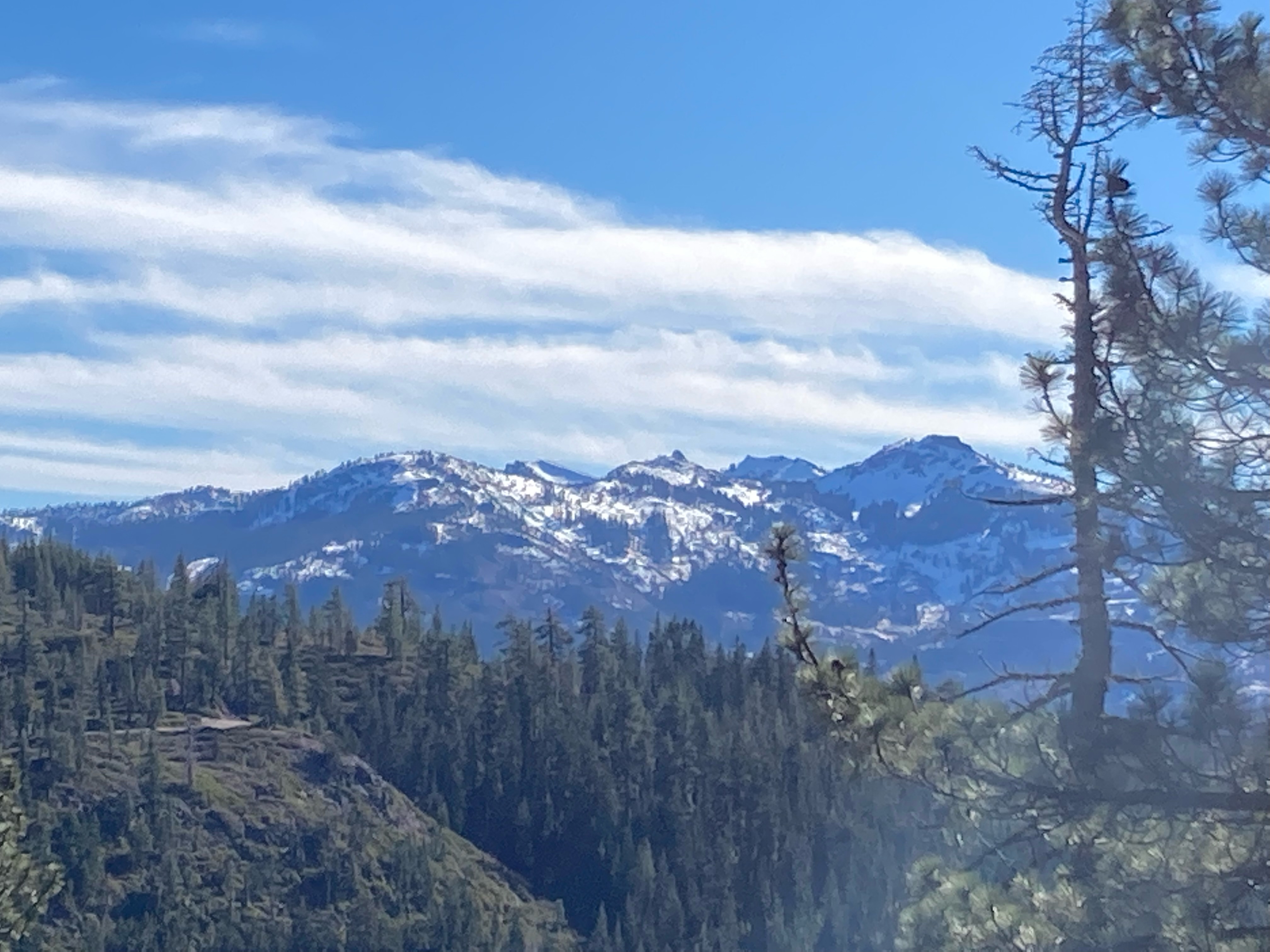
In mid-November we spent a weekend in the mountains with Santa Barbara friends who own a cabin in Soda Springs. All the ingredients for a magical time were present. Pristine air suffused with pine scents, sunshine, mild temperature, shimmering snow alongside patches of green, rushing water, a peaceful lake, breathtaking views of snow capped jagged peaks of the Sierras, the delightful company of dear friends, and hearty food. At about 7000 feet altitude there was snow on the ground around their cabin. The weather systems called atmospheric rivers of late October and early November dumped snow at that elevation. Luckily for us, the weekend was unseasonably mild so we had the benefit of enjoying a sort of winter landscape in warmish weather. On a 6 mile hike along a creek and through heavily scented pine forest we caught views of the Sierras topped with light snow. Emerald grass poked through the ground that had been parched much of the year. What a heartening sight.

Snow in November in Soda Springs


Covid Status in November

All through fall the Delta variant of the coronavirus kept us anxious. Even though the infection rate in the Bay Area was low the stories of breakthrough infections and waning vaccine effectiveness kept us fuzzy about whether the pandemic would ever end. In late fall infection rate jumped in the USA and Europe. South Africa was looking good with under a thousand new daily cases. Deaths dropped to double digits. 

Health experts expressed optimism about the future. A winter surge was expected, but not a big one. Studies from Israel showed booster shots to be effective in preventing breakthroughs and hospitalizations. Also, new treatments - antiviral pills from Pfizer and Merck - were expected to be available, further reducing hospitalizations and deaths. The SARS-CoV2 virus outsmarted experts often enough that nobody dared to predict when the pandemic would end.

Then, the day after Thanksgiving, a new chapter of Covid began. It was a pleasant, sunny day in Berkeley and after a couple hours of reading on the patio of Cafenated, I returned to our apartment and opened up the New York Times on my iPad. That was when I learned about the panic around a newly discovered variant of the SARS-CoV2 virus in South Africa. The many mutations - the most ever seen thus far - had alarm bells ringing all over the world. Vaccine evasion was the urgent concern. My heart sank. South Africa had been making remarkable progress since coming down from their winter surge. Their new daily infections deaths were at an all time low. And suddenly, just this past week, the situation switched. New case numbers doubled every day.

The new variant, named Omicron by WHO, dominated the news in the days and weeks that followed. The USA, much of Europe, the UK, and a host of other countries imposed travel restrictions on South Africa.  This was devastating to a country that was preparing for the return of international tourists during their festive season. Their infectious disease experts, highly qualified and eminently well-trained, felt they were being punished for being transparent. 

Of course, since the Omicron variant was brand new, predictions couldn't be made. We'd had so many bad twists and turns with this virus. Was 2022 going to be yet another pandemic year?The entire world let out a mega scream. Pfizer and Moderna quickly announced immediate work on lab tests.

Days after the news of Omicron broke, amid the gloomy speculations, there was one piece of promising news from a South African clinician, Dr. Coetzee, who first detected a change in her Covid patients and suspected a new variant had emerged. Everyone who came into her clinic presented with mild symptoms, mainly severe fatigue and headaches. Her guess was that this variant, unlike Delta, may not lead to severe illness.

On that somewhat optimistic note we packed up our things and got prepared for a month in Hawaii.


24 September 2021

Pacific Northwest Road Trip August 2021

When Daryl and I planned a one month road trip - our first vacation since March 2020 - all signs pointed to a summer of freedom and joy. But two weeks before our departure the Delta variant went on a rampage, yanking us out of our post-pandemic complacency. Luckily, our vacation was centered around the outdoors and we were able to accomplish much of what we set out to do.

From our Goleta, California home we headed north, hugging the coast as much as possible up to the Olympic Peninsula in the state of Washington. From there we turned southward, heading inland, first to Mount Rainier National Park, then to the Columbia River Gorge, Mount Hood, the Central Cascades of Oregon, west to Eugene, south past Mt. Shasta and ended in Berkeley, California.

Driving up Highway 1 on a cloudless summer day, our spirits soared. It was a Sunday and everywhere we stopped - Shell Beach for a picnic lunch, Morro Bay's waterfront to smile at otters, the San Simeon pier for a stroll - vivacious families were out and about. Pandemic? What pandemic? On our first night we decamped at the official start of the Big Sur Coast, a headland occupied by the overpriced Ragged Point Inn. From a strategically situated bench on their landscaped grounds we gawked at rugged cliffs and churning ocean over a picnic dinner which included a delicate artichoke tart (also overpriced) from the onsite restaurant. 

The next morning we negotiated steep curves on an improbable highway carved into California's Coastal Range. Thankfully, the large number of pull-outs enabled full enjoyment of the jaw dropping views from dizzying heights. Big Sur was sizzling in summer heat when we made our first stop at the Julia Pfeiffer Burns State Park. California Condors circled overhead, offering a ceremonial welcome. 

Waterfall at Pfeiffer Burns State Park, Big Sur

The trail was only partially open due to recent fire destruction, but we managed to get to a viewpoint from where we could see the highlight - a waterfall, barely visible and overshadowed by the shapely cliffs and water hues. On a previous visit years ago the waterfall was a mesmerizing spectacle as it spewed out a great volume of crystal clear water. The effects of years of drought were hard to ignore right from the start of our trip.

Two Big Sur favorites had to be sacrificed. Nepenthe - due to an endless line of cars at the entrance - and the Big Sur Bakery - closed on a Monday. But a picnic lunch (burritos) followed by a leisurely stroll on Pfeiffer Beach under a cloudless sky amply compensated for that. Quite a lot of people were enjoying this picturesque beach, which felt a bit strange. A scene from normal times. Covid numbers were on the rise. Was it just a tease before everyone retreated again?

Estuary near Point Reyes

We had a full morning to appreciate Marin County's beguiling coast when, at sunrise on a Tuesday morning we drove in dense fog to beat the traffic across the Golden Gate Bridge. We'd spent the night in Half Moon Bay, where we had dined at an excellent Indian restaurant after a vigorous beach walk. Bridge and city skyline views were well hidden as we wound up the coastal mountain on the north side of the bridge and descended down to Stinson Beach. What a delightful place with its posh cafes and stores bordering an inviting park! We couldn't have asked for a better breakfast stop to enjoy our first cafe croissant and coffee of our vacation. 

Later in the morning when we stopped at Point Reyes for lunch supplies we were fully reminded of the pandemic. Starting that morning masks were again mandated to enter all public indoor spaces in 5 Bay area counties. This was California's most vaccinated county, populated by a largely upper middle class progressive demographic. No wonder it was so easy to find rustic bread, local cheeses and lush salad produce for a picnic lunch!

Humboldt State Park

It's shameful that it's taken us this long to visit the famous redwood forests in Humboldt County and north toward the state border. There was never any doubt that we'd love the experience. That was why we decided to go for full immersion and camp in the forest for three nights. Before arriving at our first campground I was apprehensive about evening weather. We'd just spent a couple days with friends near Mendocino where a persistent chill had numbed my toes and fingertips the whole time. Would the temperature and fog be worse further north? Not at all. We were blessed with bright sunshine, warm days, warm evenings everyday. Days on trails that wove around ancient giants followed by evenings around the campfire felt cleansing, therapeutic, restorative. The drive up the Avenue of Giants through Humboldt State Park - a narrow stretch flanked by towering beauties - was an experience that will stay with me forever. 

To get to Del Norte State Park from Humboldt, Daryl chose the more adventurous route via Mattole Road. We stopped a few times along the first third of what was more a lane than a road to hike through groves of ancient, majestic redwoods. About a third of the way along the road the forest receded. The surface, now unpaved, became increasingly rougher. I held my breath as we climbed up a windy bit, anxious about the miles ahead. How much worse was it going to get? What a joyful moment when we finally saw the ocean and merged with Highway 101!

Smith River at Jedediah Smith Redwoods State Park

Warm, sunny weather in the northernmost part of coastal California surprised me. Thankfully, the forest shade ensured perfect hiking conditions. On our last day in the redwoods as we dodged hikers on a popular trail we unexpectedly emerged onto an open area with full sun exposure. A serenely gorgeous river - the Smith River - came into view and a lot of foot traffic headed toward a gravelly bank. Daryl was not going to pass up the opportunity to cool off in that clear water. Quite the symbolic way to bid adieu to this unique bit of our planet.

Oregon

Winchester Bay, Oregon Coast

A saunter on the untamed beaches of the Pacific Northwest guarantees a dopamine spike. Forest clad mountains meet sandy beaches. Driftwood piles mimic elaborate works of sculpture. Rocky beaches at low tide expose a great variety of sea creatures. Crossing into Oregon the visual splendor is magnified. Craggy headlands. River mouths. Lush forests. And picnic areas and trails to admire the scenery are plentiful, accessible and free. So much more egalitarian than California where you have to pay a $10 fee to enter beaches which form part of the state park system. In southern Oregon we climbed up dunes on wide sandy beaches, then meandered over toward the river bank via a forest. The coast road was busy, many camper vans and RV's, and the entire stretch was pretty built up with a chain of towns - each uniquely cute - merging into each other all the way up to the Columbia River mouth.

Oregon beach close to Washington border

Closer to Washington the beaches were rockier. On a deserted beach near Seaside, Oregon we were astounded by the sea creatures on a creviced rock. We desperately needed a mood boost because we had just spent a disappointing night at an overpriced awful motel in Garibaldi, a modest fishing village north of Tillamook. Our timing was perfect. The tide was out and there was so much to see. The many bright red starfish stole the show and filled us with joy.
Bridge at Astoria

Before leaving Oregon we pulled into a viewpoint to admire the stunning bridge at the mouth of the Columbia River. Astoria, on the river bank, looked attractive, and we were tempted to explore lunch options there, but Covid numbers in the state were shooting up. We drove on, across that impressive bridge, and a short while later arrived at a picnic area with water views. A peaceful, safe place to enjoy a lunch of bread, cheese, salad and fruit.

Washington

Sunset from Ocean Crest Resort, Moclips, WA

Ocean Crest Resort at Moclips is not one of those pretentious five star places, but our two nights here felt indulgent and luxurious. Perched up on a vertiginous cliff overlooking the Pacific, this was a place to engage full vacation mode. The pool, jacuzzi, sauna, massage rooms and exercise rooms were inside a giant wooden structure which oozed Scandinavian charm. We could easily have spent our entire two days in the pool and sauna. But the beach below the resort, reached by descending a wooden staircase, was so irresistible. And it went on for miles in each direction. All around the hotel grounds there were seating areas to enjoy sublime sea views, which climaxed at sunset. This far north the spectacle occurred close to 9:00 PM in early August.

 For evening meals we drove to the planned upmarket community of Seabrook, two miles south of Ocean Crest Resort. Over an unforgettable wood-fired pizza on one evening and an exquisite Mexican meal the next, the town's character revealed itself. I was reminded of a typical European small town in summer with vibrant cafes and locals hanging out in public spaces. Seabrook was a 21st century version of such a place. No doubt a wealthy, urban set lived in the stately two storeyed homes that fringed the downtown core.

Lake Quinault

A week in the Olympic National Park was next on our itinerary. Research, which included advice from friends, helped us create a sensible plan that ensured sufficient time for the main attractions. It was a short drive from Moclips to Lake Quinault, a serene lake framed by forested hills. We captured this photo from the lawn of the historic Lake Quinault Lodge. In the temperate rainforest nearby we followed a one mile loop which served as a primer to the park's old growth firs, cedars and hemlocks. Ferns, mosses and a gurgling creek enhanced an already enjoyable walk. 
The Pacific Northwest was gripped by a heat dome on that day- the second one this summer. As a result, the day's highlight, the Hoh Rainforest, was far from a typical experience.

Hoh River and the Hoh Rainforest


It was impossible to imagine the usual chill and dampness of the area as we endured tropical temperatures and humidity. Moss-covered tree trunks and vivid ferns seemed unreal. The trails were crowded, something we anticipated with dread when we had to wait a whole hour in bumper to bumper traffic at the entrance to this section of the park. The trail along the Hoh River goes on for miles and miles, providing ample opportunity to be wowed by Sitka Spruce, Douglas Fir, Red Cedar and Western Hemlock. But by late afternoon heat exhaustion hit and our day in paradise had to end. 

Intense heat lingered for days. Fortuitously, the beaches west of Forks - our base for the western part of the park- were on the schedule.
Rialto Beach near Forks, WA

Second Beach at La Push, accessed via a trail through rainforest, reminded me of the beaches in Thailand. Tall rock stacks, like the karsts of South East Asia, jut out of the water close to shore. Emerald forests come right down to a wide, sandy beach. But it was Rialto Beach that stole my heart. Here, the rock stacks reminded me of mythical characters. Walking on the rocky beach felt like a foot massage. I picked up smooth, polished rocks, admired their colors and shapes and hated having to toss them back.


Sol Duc Waterfalls

Between the unremarkable, logging town of Forks and our next base, Port Angeles, lies the seductive Sol Duc Valley. Here, we started the day at the sumptuous hot springs resort. Is there anything more pleasurable than soaking in heavenly pools fed by natural mineral springs in a blissful setting of cliff walls and forests? 
When our hour was up (Covid limitations) and we switched from swimsuits to hiking clothes it took some effort to summon the energy for a hike. Luckily the ascent was gentle and the reward - a trio of thundering waterfalls - most satisfying.
Crescent Lake


By the time we arrived at Crescent Lake - after the hotsprings, waterfalls hike, and picnic lunch which included big slices of Marionberry pie - we were ready for a siesta. We set up our outdoor folding chairs in the shade near the shore and read and napped through the afternoon.
Hurricane Ridge, Olympic National Park

Port Angeles, a short drive from Lake Crescent, is sandwiched between the San Juan Strait and a jaw-dropping mountain range. Despite its picturesque location we found the town center surprisingly dull, except for the part near the ferry terminal where a cluster of hip restaurants provided lively atmosphere. Even the paved promenade along the waterfront was ghostly. 
As a base to the mountains of the Olympic National Park, Port Angeles was perfect. The Hurricane Ridge Visitor Center was just a short drive out of town. Surely the most spectacular setting of any visitor center? It was the view of Mount Olympus, the highest peak, that drew gasps from everyone around us. At the same time, when I turned my gaze to the patches of snow capping the ridge my heart sank at the stark reminder of climate change. A decade ago, even in midsummer, Hurricane Ridge would've been significantly whiter. 
The steep, mostly paved trail that wound up to a summit was full of foot traffic. With travel options so limited, the national parks drew droves of domestic visitors this summer. Somewhere along the trail my phone beeped with a message welcoming me to Canada! Indeed, when we reached the top we could see Vancouver Island in the distance. The view of Port Angeles was breathtaking, but it was the saw-toothed mountain ridge, sharply clear, that commanded my gaze for a good long while. When we returned to the visitor's center I was eager for more. We checked out the shorter trails that went up in different directions and the views were equally arresting. On the drive back to town in the middle of the afternoon I was amazed to see thick clouds racing across the valley and I realized how lucky we had been. 
At dinner time we were ready for a high carb feast. Barhop Brewing near the ferry terminal provided a satisfying trifecta of flavorful IPA, "artisan" pizza and lively atmosphere on a terrace with a waterfront view.

After an unforgettable week at the Olympic National Park we headed further north to Puget Sound.  

Cornish Pasties, Port Townsend, WA

During our 2 full days in atmospheric Port Townsend we entertained thoughts of retiring here. Who could blame us? Its geography (on a sound) plus its attractive colonial style architecture bestow an immediate "wow" factor. We stayed at The Water Street Hotel which is in a historic building, placing us in the heart of the action. After breakfast each morning we strolled past the harbor, hopped down to the beach - the tide was low each time - and sauntered toward the Point Wilson Lighthouse. Blue sky, the hum of locals and visitors engaged in beach and park activities, sea birds circling and swooping, the wet sand soft and nurturing. We were infatuated. 
 The variety of upmarket restaurants strengthened our impressions. Where else in America can you find "made from scratch" vegetarian Cornish pasties stuffed with vindaloo curry? Small parks with picnic tables all over town ensured blissful settings at meal times. (Due to growing Covid numbers we opted for take-out over dining at restaurants.) 
On the day we were leaving town we popped into the food co-op for meal supplies. Three nights in a cabin with a kitchen at Mount Rainier's southern entrance awaited. We were excited about home prepared meals for the first time in weeks. And when we found a heartening variety of high quality seasonal produce as well as an incredibly well-stocked deli at the co-op our affection for Port Townsend deepened. We left town wondering whether we'd return as new residents or never see it again.

We headed south. The start of our journey back to California. We crossed attractive bridges into and out of Bainbridge Island as we made our way west to the range of mountains called the Cascades.
Mount Rainier

Drizzle and cloud cover on our two days at Mount Rainier National Park did not deprive us of exhilarating hikes. On our first full day at the park, since the mountain we were here to see was well hidden in dense cloud, we settled for a forest hike that involved a long, steady climb on a trail cushioned by mulch. At the viewpoint from where Mount Rainier would be visible on a clear day, we munched a sandwich and stared into the mist. The temperature for me was ideal for hiking. In the afternoon, still full of steam, we hopped onto an easy stretch of the mostly strenuous Wonderland Trail. This 93 mile long trail encircles the mountain, and we were on a level bit near Cougar Rock Campground alongside a gushing river churning white water.
 
On our second day at the park we hiked the super popular Skyline Loop Trail from Paradise Valley for the best chance to see the king of the Cascades. The weather looked promising with less cloud cover than the previous day. An early arrival granted us a prime parking spot in a lot that was rapidly filling up with Seattle day-trippers on this August Sunday. We started our ascent on a quiet stretch through meadows brightened by wild flowers and reached Myrtle Falls. We paused here for a few minutes to absorb the beauty of the waterfall, then continued on the ascent, still puzzled at how few people we encountered. The final bit required some rock scrambling (to my dismay), but once at the summit I was dumbstruck. A shimmering white mound towered above me. I gazed at the glacier clad contours, transfixed. This moment, I knew, would be the climax of the month long road trip.When I finally became aware of the world again I was amazed to see that we were far from alone. How did all these people get there? Turned out we were doing the loop in the opposite direction. Had we done it the traditional way, the climb would have been considerably steeper - up endless steps - but Mt. Rainier would've been in our view much of the time (depending on cloud cover). Doing it in reverse made the downhill section absurdly easy, but we encountered hordes of visitors. On the drive out of the park we wondered if Seattle's proximity to this park placed it above Port Townsend as a retirement home. 

Columbia River Gorge

The route we selected for the drive south from Mt Rainier was supposed to provide close up views of Mt St. Helens and Mt Adams. But the weather that Monday morning did not co-operate. We drove in cloud, drizzle and mist, a guarantee of poor visibility much of the time. To make matters worse, as we approached a pass the paved road ended and we entered a rough, bumpy stretch. How did this happen? We'd done our research and the road had looked smooth and paved on Google maps the night before! Immense relief washed over us when the road widened into a normal two lane highway again near the Columbia River!
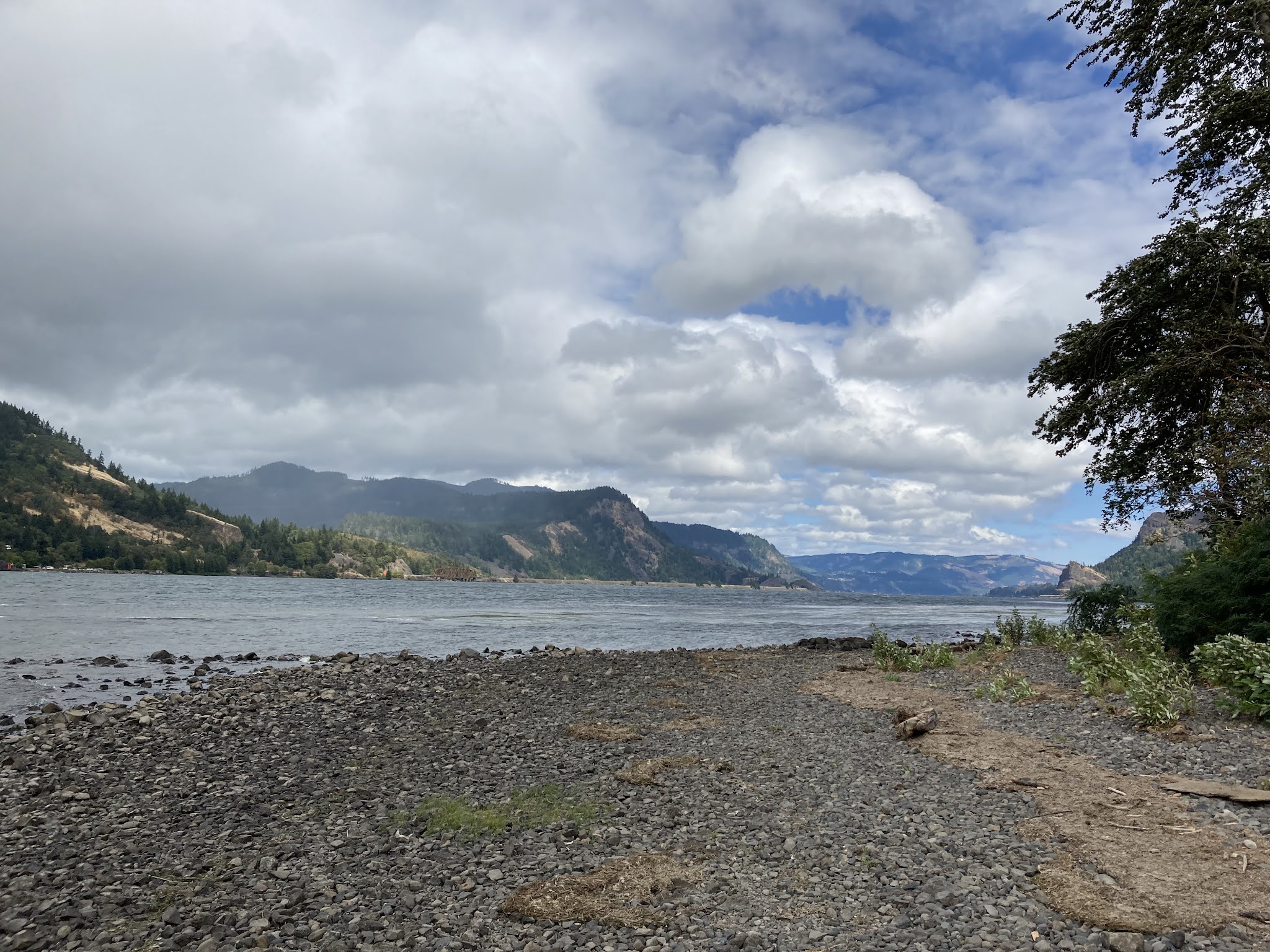
This mighty river originates in the Canadian Rockies and on its journey to the Pacific Ocean is fed by numerous rivers. At the point where we crossed into Oregon, the Columbia River cut through a gorge in the Cascades. We intended to camp in this geologically intriguing region, but changed our plans when we saw the charmless campground at Viento State Park near busy Highway 84. We opted for a room at a pleasant motel in lively Hood River, a town which occupies arguably the best location in Oregon. 

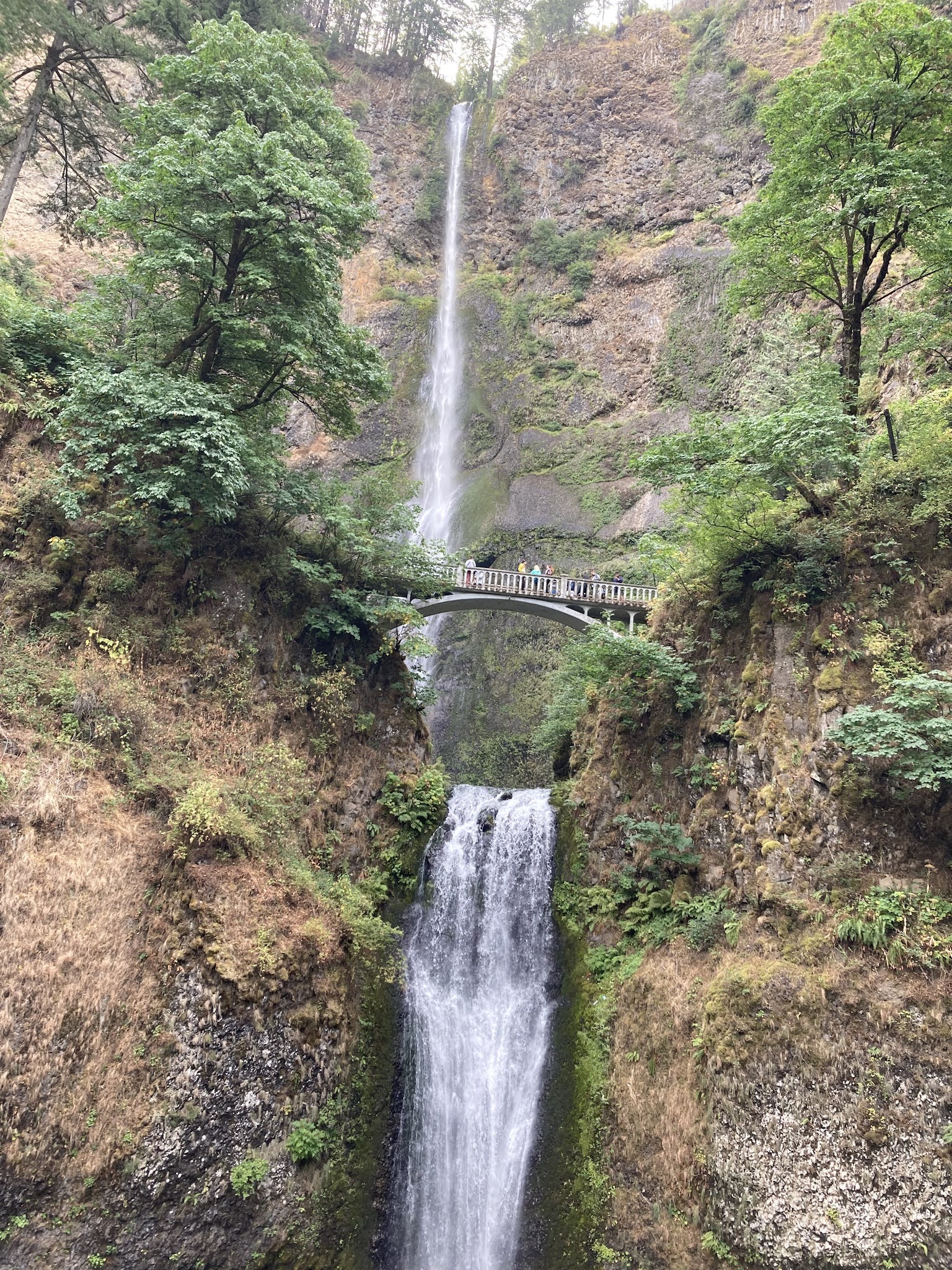
Multnomah Falls - one of the tallest in the nation

Undoubtedly, the highlight of the Columbia River Gorge is the tall, multi-tiered Multnomah Falls. When we'd arrived at the entrance, via the historic byway, we were told we needed a ticket that had to be purchased in advance online. Due to Covid this was a way to limit numbers. After fiddling around with the online procedure on our phones without success, we were eventually let in and immediately stepped onto the steep trail to the top of the falls. Invigorating and rewarding, we relished every moment.
 
Back on the byway, an engineering marvel along a cliff wall, we made stops at the other waterfalls in the area. Each endowed with its own charm and compelled hikes to viewpoints. Past the waterfalls the road arcs and ascends up to Crown Point. From this spot we gazed at the bird's eye view of vertical cliff walls and wide, wide river visible for many miles. A heart stopping panorama that can only be fully appreciated in real life.
Mount Hood from Mirror Lake


Before leaving Hood River on a cloudless Tuesday morning we caught a great view of Mount Adams from the motel parking lot, and in the cute downtown, we acquired delicious bagels from a bustling bakery. These unexpected parting gifts left quite an impression. The town of Hood River sure had a lot going for it. Minutes after heading south on scenic Highway 35,  Mount Hood came into full view. A symmetric partially snowcapped dome proudly displayed above an agricultural plain. We drove through farmland, stopped at one of the many farm stands, bought a huge bag of freshly harvested pears (which didn't make it to California due to border regulations), and continued onward to a trailhead for our first hike of the day.

Though not as ostentatious as Mt. Rainier, Mount Hood is more accessible, with numerous hiking trails at its base. My favorite was the trail to and around Mirror Lake for its ideal combination of forest, gentle ascent, scenery and views. A night at Cooper Spur Lodge provided luxury, which included an evening hot tub soak under the stars. On a future visit we may spend a night at the Timberline Lodge for even more luxury in a historic wooden building right up the mountain. The Pacific Crest Trail goes past this lodge and we hiked a small part of it just so we could brag about it. 

Heading south to the central Cascades we encountered smoke from wildfires for the first time on this trip. The mountain peaks we hoped to have views of during the drive were completely invisible. East of the Cascades we entered high desert landscape. Now we were immersed in browns and tans, descending and ascending steep canyons until we arrived at a heavily irrigated agricultural plain. 
We stayed at an Airbnb just outside the town of Sisters, Oregon. Though the fires were a fair distance from us the sky was hazy and poor air quality lingered for two days. Luckily on our last full day in the area we woke up to a bright blue sky. We finally could see the iconic Three Sisters, a trio of volcanic cones, from our window. From the road near our Airbnb we could see Three Fingered Jack, Black Butte and Mount Washington. 
The highlight for us in the Sisters area was a hike around Suttle Lake, a clear blue lake that arose from glacial run-off. The combination of sun, perfect air temperature, pine scents and natural beauty gave us a high, and craving more, we extended our walk through a wooded trail along a creek. 
Suttle Lake, Sisters, OR


Blu Pool on the Tamolich Trail in the Central Cascades

From Sisters we drove east to Eugene over a pass to the western side of the Cascades. Between the two cities we stopped for one last big wilderness hike. On the Tamolich Trail we arrived at a truly arresting sight, a pool the color of sapphire. It was still early on a Sunday morning. In a few hours this spot would be crowded. Continuing beyond Blu Pool, we hiked beside the McKenzie River, into a delightful forest infused with earthy scents. The trail was mostly level and pretty quiet. Our road trip was coming to an end. Next on the itinerary was a city stint.
It isn't Nature!


Our LA friends welcomed us to their new home in Eugene in style. During our short stay with them they showed us their favorite walks and yet another city began to seduce us. At the end of each day, over Willamette Valley Pinot Noir and a variety of blue cheeses we chatted, laughed, complained, grouched, smiled. The past 18 months had been tough in a number of ways. But the worst was over and we had plenty to smile about.


19 July 2021

Delta, South Africa's Horrors, and other Disasters

July 11, 2021

High summer in California. Hot days due to a high pressure ridge in our region. In parched California fires are already ravaging forests. And Covid is becoming a problem in our state again. When I read that LA county has had over a 1000 new cases in the past 3 days my heart sank. There are too many unvaccinated people out there and this does not bode well for the weeks ahead. Ouch!

Sydney, Australia reported 70 new positive cases today. South Africa's lockdown has been extended - obviously - their numbers are climbing. In the UK, new daily cases now just over 30,000.

Hogging headlines around the globe today is the Euro 2020 Soccer finals. In a tight match between Italy and England, Italy squeezed out a win in penalties. Gloom fell over the UK, which hosted the game, while Rome partied.

July 12

Biggest news on this Monday is the distressing situation in South Africa. Former "corrupt to the core" president Jacob Zuma was arrested for contempt of court when he refused to appear on a corruption charge. This sparked an eruption of violent protests in Zulu strongholds - KwaZulu-Natal and Gauteng. It boggles the mind that such a pathetic specimen could have such a passionately loyal following. Ah yes, the comparisons to Trump are unavoidable. Freight trucks on the main freeway out of Durban were set alight. Cars were stoned. Grocery stores looted. And they threaten to continue until their "hero" is released. Commercial centers in affected cities were shut down. Videos of looters grabbing goods from stores went viral. President Ramaphosa addressed the stunned nation at prime time, assuring an appropriate response. The army has been deployed. Arrests will be made. Vandalism and violence will not be tolerated. When I spoke to Mum on the phone this morning she was in shock and deeply disappointed. My brother too, was shattered. Mainly, he wondered about the future for his two school age boys.

Meanwhile Covid cases in South Africa are soaring. Currently over 20,000 recorded new daily cases. Hospitals are filling up. And now, with pharmacies vandalized, vaccinations are once again hampered. I'm so heartsore about this.

Global Covid news is once again turning bleak as the Delta variant wreaks havoc. In the US we are definitely looking at another wave due to vaccine rejection. For a week now the average number of new daily cases hovered around 20,000. In my county daily new cases have risen from single digit to double digits.

The UK government is sticking with the decision to fully reopen on July 19. Though new daily cases continue to rise - over 30,000 - hospitalizations are expected to be low due to a largely vaccinated population. The mindset now is on how to live with the virus.

European countries have started to see a reversal in their progress. New daily cases now climbing in France, Portugal, Greece, and Spain. It's so disappointing to see this happening.

July 13

Woke up to more horrific news from South Africa. The unrest has escalated to an alarming scale. KwaZulu-Natal is ungovernable. I watched SABC video footage of looters grabbing appliances and all manner of goods from warehouses and stores lining Umgeni Road. Police sirens could be heard but no arrests were made. It looked like anarchy. More video footage of vandalizing and looting in Soweto where again there was no police intervention. By day's end many of Durban's shopping centers and malls were burned to the ground.

Today, much anger was directed at President Cyril Ramaphosa. Why did he not take action? Yesterday he announced the deployment of the army. But the opposition party, EFF, immediately objected strongly. A political problem demands a political solution they declare. The head scratcher is what is that solution? The situation has moved from protesting Zuma's arrest into plain old criminality. When I spoke to my brother today he was absolutely crushed. He said they had heard gunshots during the night. "I've never seen anything like this in my life before," he said. Heartbreaking.

July 14

It was a calmer day in South Africa today. Looting still going on in isolated spots, but a less frightening scenario. Explanations for a reluctance to declare a State of Emergency and restraint from the army were offered by news analysts. Civilized governments do not attack civilians. A bigger concern was whether government could count on support from agencies normally used in lawless situations. The responsibility to quell the violence fell on neighborhood watch communities. At certain hotspots military personnel were deployed to help the police. Thank goodness the worst is over. Now they can return to urgent pandemic matters.

On a brighter note Daryl and I attended our first concert since our time in Sydney back in 2019. The summer festival of the Music Academy of the West is in full swing. Hahn Hall provided an intimate setting for Rachmaninoff's Trio Èlègiaque and Mozart's String Quintet in G Minor which were masterfully performed. Prior to the concert we dined at Oliver's in Montecito. Narrowing down options from their entirely plant-based menu was tricky. Artichoke cakes, jackfruit tacos and a flatbread topped with creative and flavorful stuff made for a truly satisfying meal. The vegan key lime pie for dessert was most impressive. An evening out, which required elegant attire, was such a special thing.

July 15

Mopping up operations in a stunned South Africa today. Sporadic looting and destruction still happening. Scanning SABC news clips today the focus turned to an analysis of what really happened and why. Theories abounded - from simple economics to ANC divisions to a counter-revolution. The country was a tinderbox. 

I landed on a piece from an online publication called The Daily Maverick. Professor Jane Duncan posed questions about why government institutions failed to kick in at a crisis moment? How did the Intelligence agencies not prepare for what was a clearly orchestrated attempt to destabilize the economy? She pointed out that ever since Zuma's ousting there've been extreme violent acts such as blocking the N3 with burning tires. This main transportation artery prevents essential goods from reaching much of the country. Other analyses I read pointed out that 9 years of Zuma's corruption and criminality hollowed out the nation's democratic institutions. And this was why the violence of the past days rapidly escalated and devolved into chaos. 

In summary, what really happened was that while Jacob Zuma was under investigation for his many crimes while in office, he planned his revenge. If he was going to be taken down, the country had to go down with him. So, when he turned himself in after refusing to appear in court and then resisting arrest, he'd already lined up instigators to go on the attack. Those who became obscenely rich when Zuma was president (from money meant to feed and shelter a nation) were only too willing to obey their master. Instigators lined up support and off they want, destroying vital infrastructure. The police force and the military stood back. How many of them were more loyal to Zuma than to the Ramaphosa government? And when the warehouses and grocery stores were vandalized the province's poorest helped themselves to all the goodies normally unattainable to them. Expensive sofas, state of the art appliances, TV's, food of their fantasies, etc., etc. News reporters had their cameras on the looters while reporting on live TV. The entire nation watched in horror. Was this their country?

July 19

Monday. The start of a new week. Last week was the week from hell. Awful stuff occurred all over the world. The president of Haiti was assassinated and now this impoverished nation is in chaos. In Cuba the people went on protests against the Communist regime. Germany experienced its worst flooding in decades when about 200 people lost their lives in the area close to Belgium. South Africa experienced its share of catastrophe which claimed close to 200 lives. Indonesia is experiencing a humanitarian crises from Covid and is currently the worst affected country in the world. 

The Delta variant continues on its rampage around the world, leading to new waves in countries that were close to declaring victory. The UK, which fully opened up today, is dealing with a surge similar to winter (over 50,000 new daily cases), except hospitalizations and deaths aren't a concern yet. Here in California we are definitely on our 4th wave. Sigh!!! After months of glee at declining new cases, now we're seeing huge climbs. In the past 3 days the state has clocked over 4000 new positive cases. Daily new cases in the US are now close to 30,000. It's the unvaccinated who are affected. That's half the country. And because there are no longer mitigation strategies it's become a lot easier for the virus to spread. Hopes for that predicted bright summer are on the wane. And who know what awaits us in the fall and winter!

Sydney, Australia still in lockdown. Their vaccination rate has vastly sped up. They'll soon catch up and exceed ours.

I'll end this post with good news. Last week we attended 4 Music Academy of the West concerts. Twice, we had preconcert picnic dinners with our dear friends. The pretty gardens of the academy campus provided a delightful setting for lighthearted conversation. Saturday's concert, performed by an orchestra rather than the mostly quartets and quintets at Hahn Hall, was at the Granada Theatre downtown. This gave us the opportunity to enjoy the vibrancy of the newly designed State Street - now a promenade - on a summer weekend evening. We dined at a new Italian restaurant called Opi'z where standard fare was turned into fine food by superior ingredients and creative cooking methods. At the Granada it really was a special moment to be part of an audience in a big performance hall. Of course, with Covid numbers on the rise again, we aren't entirely at ease in an indoor space with a crowd, so we masked up. Excellent conductor. Communicated with the audience with body and feet in a humorous way. The sublime music of Wagner's Siegfried Idyll and Brahm's Serenade #2 were balm for our battered spirits.


05 July 2021

Fourth of July is Celebrated

July 5

It was definitely a very different 4th of July compared to a year ago. President Biden gave us his assurance of this when he addressed the nation on his 100th day in office in early spring. He didn't accomplish his goal of 70% adults beginning the vaccination process by this date  - through no fault of his - but we came close (67%), and the impact has been so tremendous. A year ago leaders were imploring caution as we entered the holiday weekend. Overcrowded beaches and parks were a huge concern. This year gatherings were in full swing. Firework displays were back. 

The 4th fell on a Sunday and we hosted a dinner on all three weekend evenings out in our garden. Rob and Katie on Friday evening told us all about their passion for rock climbing. They took on famous mountain slopes for multiple day climbs. Sleeping on a rock ledge? No thank you! We saw Jennifer and David for the first time since their wedding. Traveling to Tahiti was a big topic. On Sunday evening Katya, Hugh, Bruce and Janette brought potluck contributions and the 6 of us feasted on summer's bounty. We each shared our experiences and impressions of arriving in America after having lived abroad. What a great conversation theme that turned out to be since each of us had such unique perceptions.

Though our day to day lives feel so normal these days, Covid news is far from benign. The Delta variant is delivering a new plot twist, and returning pandemic news to the front pages. Delta is outcompeting the Beta strain in South Africa and has caused a steep spike in cases as the country weathers its third surge and another lockdown. The fragile economy will be crushed but there doesn't seem to be an alternative. Thankfully, Mum is now fully vaccinated. The vulnerable and the essential work force is currently prioritized for vaccination and I'm sure that will translate to a manageable situation.

More surprising is Australia. A cluster of Covid cases was traced to an airport limousine driver two weeks back. When positive cases grew to a total of 128, the premier of New South Wales imposed a lockdown. Sydney is experiencing its first lockdown since April 2020. This is major. Outbreaks in other states followed - including West Australia and a week ago Perth went into a snap lockdown after 2 cases of community spread. Australians, unnerved, are furious at the sluggish vaccination pace in their country.

The UK's surge is of interest to everyone. What impact will the Delta variant have when almost half the adult population is vaccinated? Daily new cases are currently close to 25,000. That number is expected to double in 2 weeks. However, Boris Johnson is determined to open up fully on July 19. Israel, the world's most vaccinated population, has been battling a rise in positive cases for the first time in many months. Today, they released a study showing that Pfizer is 64% effective against the Delta strain in preventing symptomatic illness, but over 90% effective in preventing hospitalizations and death. Here, in California, and in the US as a whole, our new daily cases have started to trend up. LA County's health department is suggesting that the vaccinated wear masks in indoor public settings. Not the news we want to hear after months of progress. The tension doesn't let up.

Just wanted to note that Europe is doing well. In Germany and France new daily cases are below 1,000 and vaccination has sped up. Canada is another bright spot. They now have a bigger percentage vaccinated than us.

The next weeks will reveal a lot. Data from the UK will inform exactly how serious the Delta variant is. Its transmissibility is clear, but is it more deadly? Though India took a beating from Delta, it's harder for researchers to crunch data from there. In an article I read in the Atlantic two days ago, Ashish Jha, an infectious disease expert, expressed certainty that everyone will eventually develop immunity. The unvaccinated will eventually contract the virus. It's a matter of time. 

Other News

Hogging the headlines in the past two weeks was the collapse of a high rise apartment building in Surfside, Florida. The cause, structural missteps, makes this especially tragic. Over 100 people are still buried in rubble despite ongoing rescue efforts.

Then there's the saga of the postponed 2020 Olympics in Japan. For some unfathomable reason, the host country has an overwhelming unvaccinated population. But this summer, despite controversy and concern, athletes from all over the globe will participate in the usual games we've come to expect every 4 years.

Despite the ongoing upheaval globally, life is significantly better for us here in California.

21 June 2021

Early Summer in Post Quarantine California

June 4, 2021 

New cases: USA 17,800; California 1,168; UK 5, 274 (going up); South Africa 5,360 (going up)

The India variant dominates in the UK and is the most worrisome strain currently.

The White House is going all out to push the unvaccinated to get their shots. The goal of vaccinating 70% of American adults by July 4, though achievable, will require huge effort. Future generations are going to view this period with amazement. How could the public health situation become so politicized? A cluster of "red" states in the South have a long way to go to reach President Biden's goal. Why are so many people apathetic to the situation?

Our region is doing remarkably well. On June 3 I visited my favorite hair salon for the first time in over a year. Everyone wears masks in this transitioning time, but I was perfectly relaxed as my upbeat stylist colored and cut my overgrown, "badly in need of attention" hair. After all these month I smile rather than cringe when I look in the mirror. How wonderful it is to have no anxiety about shopping at stores or dining at restaurants. A week ago we took in the vibe at Hollister Brewing Company over craft IPA and pizza. Last night we scouted out the Funk Zone and settled for craft beer, Impossible burger, and cauliflower tacos at the very popular and atmospheric Finny's. 

This week the fog returned after a one week break. Comforting to see a return of May's typical pattern of grayness which was broken in the last 8 hotter than usual years. On a gloomy, chilly Tuesday morning I sucked in the briny air of Goleta Beach as I jogged on the damp, compact sand. A guaranteed mood booster - a discovery I made under quarantine. Two days later I went on a 20 minute run at Stow Grove (I do miss the beautiful trees and birdsong of this park), and followed that with my gym routine. I'm pleased with my fitness level. 

June 10

A hot sunny day today after a spell of chilly, foggy weather, broken fortuitously on Sunday when we experienced a "before times" day in the company of about 70 people at a wedding. Under a clear blue sky on the coastal cliffs of Dos Pueblos Canyon, Jennifer and David exchanged vows in a magical setting. What a special occasion to usher in our entry into post quarantine life! The reception in glass hothouses that were built to cultivate orchids decades ago added oodles of charm. The guests, too, were loads of fun. Most fascinating were friends of David's dad who had worked on the creation of the Lunar Rover 50 years ago. It was a beautiful day and well deserved since the pandemic forced this lovely couple to cancel their original date. The celebrations continued the next morning at Jennifer's house over a brunch feast prepared by Premi and Sri. What joy to revert to social practices that tether us to community.

That's not to say the pandemic is history. Covid numbers are climbing steeply in the UK and in South Africa where the anticipated winter surge has the country on edge. Here, in the US, experts are beginning to warn about the Delta variant (from India) which appears the most virulent strain currently. Vaccination efforts have stalled and a cluster of Southern states could avoid disaster if they followed the science. Between 15,000 and 20,000 daily new cases in the US recorded this past week. Daily deaths around 300.However, since Florida and a handful of other conservative states have stopped submitting daily reports, it's hard to discern progress.

June 15

A hot spell is upon us. Not welcome in our parched state. We fear a summer of wildfires. But, on this big day in California, everyone is smiling. Our economy is just about fully opened for the first time since March 19, 2020. Good-bye color tier system, mask mandates (except for specific circumstances which are federally mandated) and other Covid restrictions. Hello live concerts, movie theaters, nightlife, restaurants! How amazing to have arrived at this point! Over 70% of adults in the Golden state are at least partially vaccinated. Remarkably, our progress has been steady since January. 

The pandemic story is far from over though. While wealthy countries are well on the road to returning to normal, the rest of the world struggles on. The Delta variant is on a rampage. It's the reason Daryl and I made the decision to cancel our August flights to London. Covid numbers in the UK are still rising. South Africa is back under semi lockdown. India's numbers are coming down, but they are also battling a new disease called Black Fungus.

So, each new day brings good news and bad news.

June 21

For a full week a heat wave scorched the west. Luckily for us on the coast, it wasn't unbearable. Mercifully, the fog rolled in days ago, bringing in cooler weather. Out and about on the weekend - to farmer's market, beach walk, stores - the world looked normal. A small percentage of people still stay masked, but everyone else has reverted to pre-pandemic behavior.

Two big concerns dominate Covid news in our part of the world. One is the challenge of persuading the unvaccinated to get their shots. When President Biden first announced his goal of 70% of adults vaccinated by July 4, it seemed perfectly within reach. Now, nobody expects that goal to be attained. I'm pretty disappointed about that and trying to understand what the government could've done about it. Could they have educated the public better? Should there be daily CDC messages that are broadcast widely? Are they addressing the questions individuals still have?

The other Covid concern is the Delta variant. Experts are now warning that case numbers are likely to go up in regions with large numbers of unvaccinated people. The nation's progress is about to hit another roadblock.

On the bright side Daryl and I will be on vacation for the entire month of August. Vacation! Something we could only dream about a year ago. This year we have the opportunity to do something unusual - domestic travel, specifically, a road trip up the Northwest, all the way up Highway 1 to the Olympic Peninsula, then turning back south through the Cascades on our return. Nature and scenic wonder are the focus of this vacation, which is why we won't stop in Seattle or Portland even though they are on our route. We spent 3 intensive days planning a route and booking accommodation. National Parks are already fully booked through the summer months. Our lodgings for the month will be a combination of friend's homes, tent camping, hotels, lodges, cabins and an Airbnb. Though I can't wait to get started, I'm just as eager to enjoy summer at home. Al fresco summer fare with friends, daily swims, evening strolls, beach walks - so much to enjoy.

01 June 2021

Post Quarantine Times

May 25

Santa Barbara recorded only 3 positive coronavirus cases on May 24. Single digit daily cases all week, but LA county, in the yellow tier, has been doing better than us for a while. 

During the week of May 16 to 23 the USA dropped to an average of 25,000 new positive cases. Today 50% of the adult population is fully vaccinated. 

The UK is still seeing around 2,500 new cases. South Africa is hovering at just below 3000 new daily cases. Still unsure about traveling to England in August.

May 27

Today's leading Covid news addressed the lab leak theory. US experts are exploring the possibility of a virus escape from the Wuhan Coronavirus Research Lab as the cause of the pandemic. However, they feel more strongly that the origin was zoonotic (from a bat to an intermediary host).

Cases continue to decline - now hovering between 20,000 - 25,000 new daily infections. But it's still a struggle to convince people to get vaccinated. The anti-vax movement is robust and the large percentage who receive information through their network aren't budging. Confirmation bias hindering our progress.

Over 3,000 new cases in the UK - 70% due to Indian variant. South Africa's numbers climbing - they recorded over 4000 on May 26. India's recorded numbers on a decline, but rural areas where the virus is spreading rapidly aren't equipped with testing facilities. Global daily cases on a decline largely due to Europe's excellent vaccination progress. Situation in Latin America still out of control.

On a different note - Brood X, the 17 year periodic cicadas have emerged in the North East of the USA. Photos and videos of their mating cries are everywhere.

June 1

It's the Tuesday after Memorial Day weekend. What a contrast to last year! Before the start of the holiday weekend there was a tone of excitement and optimism. Newspaper photos of the crowds waiting to board flights at airports were portrayed as a celebration. No finger-waving and head-shaking like last year. 

We, too, were swept up by the mood. We had our first overnight guests since March 2020. The joyful presence of our LA friends, Rayann and Marlene, elevated the weekend to something special. We shared special meals, heartfelt conversations, and went on a jaunt to Lake Los Carneros. The highlight was Saturday dinner on our patio. Premi and Sri joined us. Premi's vegan ceviche kicked off the meal. A chilled Rosé teamed well with it. My zucchini tart, the centerpiece, was matched with a robust Paso Robles red blend provided by Rayann. Dessert was Premi's fragrant, creamy carrot halwa. Indeed, it was a celebration of so many things.

On Monday we joined Stephen and Jacqueline for lunch at their new home in a residential compound. We hadn't experienced their legendary hospitality for a good, long while. What a delight to sit out on their shaded patio (with a view of a green cliff) and over a multi-course meal - in the traditional European style typical of them - hit as many current topics as possible! Four hours of conviviality reinforced this new, exciting phase we've entered.

Before the weekend ended Daryl and I worked off the calories we'd stuffed into our bodies on the pleasant San Antonio Creek trail which starts at Tucker's Grove. The last hours of daylight were ideal for this trail. Lots of shade, perfect temperature and a fair amount of elevation gain. Quite an endorphin rush.

Before going to sleep I surveyed the Covid landscape. The USA recorded just 8,100 new cases on Memorial Day. Yes, it was a holiday weekend when fewer tests are conducted, etc. Still. The UK recorded close to 4000 new cases. The India variant is stirring up trouble everywhere, especially in previously successful Asian countries like Vietnam, Malaysia, regions in China, Taiwan. Also learned that WHO has started assigning Greek letters to name the recent variants of concern to prevent stigmatizing countries. It appears that India has past its peak and is now on a decline. Same is true of Brazil. Europe is on a successful path - like we were months ago. I'm hopeful that they're on a one way road to success.

Last week Governor Gavin Newsom joined the lottery offer bandwagon as incentive to energize vaccinations in this state. Cash prizes of large sums of money will be awarded to individuals selected in a random drawing of all vaccinated Californians. Will it work? I haven't yet come across information on what effect the announcement has had. I'm guessing much thought had gone into this and maybe we'll have enough excitement to push the percentage up enough so that we can stabilize this comfortable situation we are currently enjoying.